
The short version
- Tiger stripes are uneven cleaning. Some strips of concrete got more cleaning than the strips next to them.
- The usual causes: a wand swept by hand at a changing distance, a surface cleaner pushed too fast or a cleaner that's the wrong size for the machine.
- Usually fixable, unless it's etched. Uneven cleaning can often be evened out; stripes cut into the surface can't.
What tiger striping is
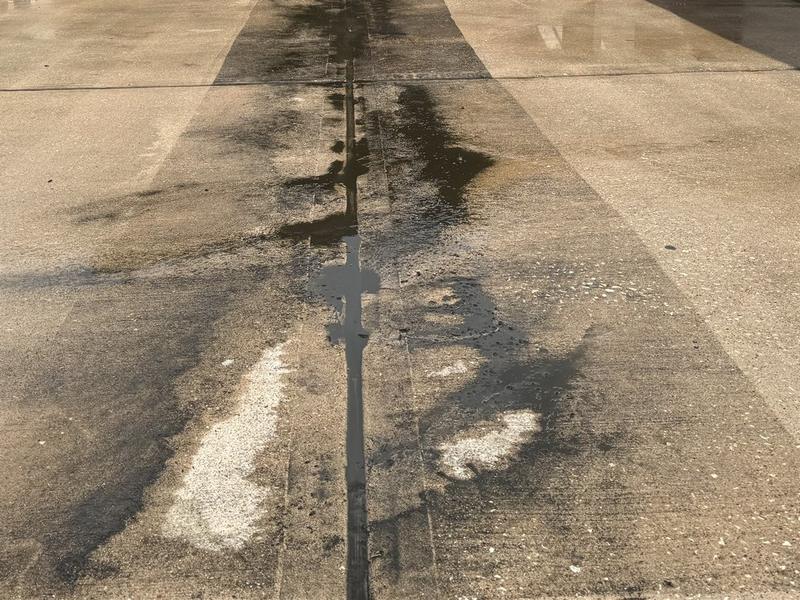
Tiger stripes (also called striping or swirls) are light and dark bands left on concrete after it's been washed. PowerWash.com, a pressure washing equipment supplier and trainer, describes them as the swirl pattern a surface cleaner can leave behind, and says they're avoidable with proper training and practice (PowerWash.com). Handheld wands leave their own version: straight bands that follow each sweep.
Either way, the light strips are where more grime came off and the dark strips are where less did. The concrete is clean in places and only partly clean in others.
The common causes
1. A wand swept by hand
A spray fan is strongest in a narrow strip, and its force changes with every inch of distance. When the wand drifts closer or farther, tilts or overlaps unevenly, each pass cleans a slightly different amount. The Brick Industry Association makes the same point about walls: effective results depend on keeping a consistent pressure, flow, distance and angle, with uniform strokes (BIA). That's hard to hold by hand across an entire driveway.
2. A surface cleaner moved too fast
A rotary surface cleaner fixes the distance problem: Mi-T-M says it keeps the nozzles at a set distance from the surface for a balanced, even pattern (Mi-T-M). But it has its own pace. PowerWash.com says the stripes are a result of walking too quickly, and that slowing down avoids them (PowerWash.com). Moving too fast means parts of the lane get only a glancing pass.
3. A surface cleaner that doesn't match the machine
The spray bar is spun by the water itself, so the right size depends on the machine. PowerWash.com notes that surface cleaner size depends on the machine's GPM and horsepower, and that using the right size is part of avoiding stripes (PowerWash.com).
4. Uneven pretreatment or rinse
If a cleaning solution is used, uneven coverage can show up the same way. On walls, the Brick Industry Association stresses that "a thorough and uniform rinse is critical" (BIA), and Georgia-Pacific recommends washing siding from the bottom up and following with a clear-water rinse to minimize streaking (Georgia-Pacific). The same logic holds on flatwork.
5. Spot cleaning
Blasting one stain can leave that spot lighter than the rest. CMHA notes that removing a stain can leave the treated area lighter in color (CMHA). Cleaning the whole slab evenly avoids a patchwork look.
Are tiger stripes permanent?
It depends on what made them:
- Uneven cleaning. The bands are differences in how much grime came off. In our experience, a careful, even re-clean of the whole area often evens them out.
- Etching. If a narrow tip held close cut into the surface, the stripes are a change in texture and won't wash out. See the dangers of etching.
The trade group PWNA teaches "proper cleaning patterns" as part of its flatwork certification, alongside avoiding etching (PWNA), which tells you how much technique matters here.
What an even result looks like
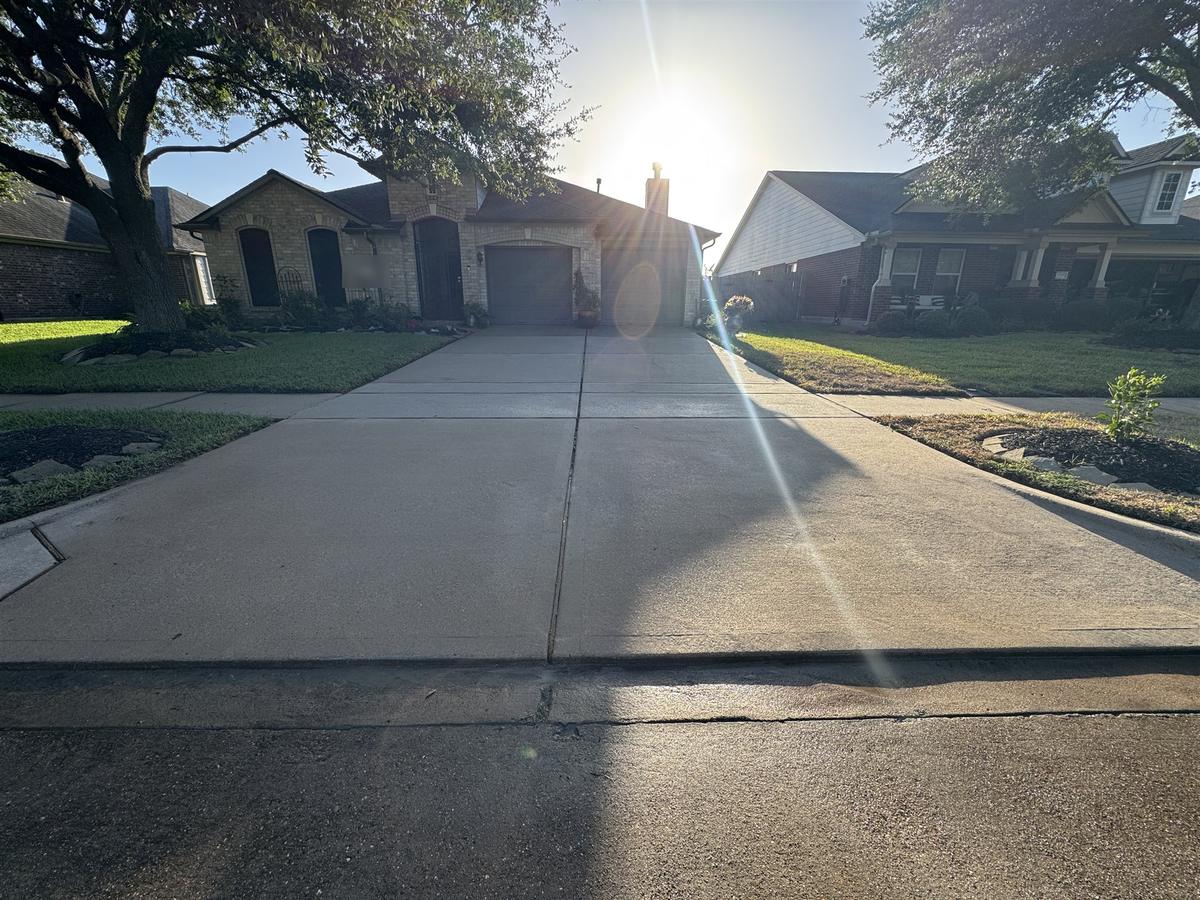
Typically, an even job shows clean lanes that blend into each other once the concrete dries, with edges and corners finished to match.

How ACE keeps driveways even
We clean flat concrete with a 20-inch surface cleaner on a 3,000 PSI, 5.5 GPM machine, working in overlapping lanes, and use the wand for edges and the final rinse. We generally apply any cleaning solution after the surface-cleaner pass rather than before it, so there's no pretreatment to go on unevenly.
On concrete, ACE's wand work uses a turbo (rotary) nozzle instead of a plain fan tip. Nozzle maker AR North America explains that a turbo nozzle turns a zero-degree jet into a rotating, cone-shaped spray, combining the intensity of a zero-degree jet with the coverage of a fan spray, and it cautions that turbo nozzles can damage soft surfaces such as wood and paint (AR North America). In our experience, that moving stream helps avoid the straight lines a fan tip can leave, though pace and overlap still matter.
Quick answers
What are tiger stripes on a driveway?
Tiger stripes are light and dark bands left on concrete after washing. The light strips got more cleaning than the dark strips next to them. Surface cleaners can leave curved swirls, and handheld wands leave straight bands.
What causes tiger striping?
Usually uneven cleaning: a wand swept by hand at a changing distance or angle, a surface cleaner pushed too fast, a surface cleaner that's the wrong size for the machine, or uneven pretreatment and rinsing.
Are tiger stripes permanent?
Not always. If the stripes are just uneven cleaning, in our experience an even re-clean of the whole area often evens them out. If the stream cut into the surface, that's etching, and it won't wash out.
How do you avoid tiger stripes?
Use a surface cleaner sized for the machine, walk it at a slow, steady pace in overlapping lanes and clean the whole slab evenly rather than blasting single spots.
Sources
- Surface Cleaner Review: How to Avoid Pressure Washer Surface Cleaner Swirls, PowerWash.com. https://powerwash.com/how-to-videos/surface-cleaner-review-how-to-avoid-pressure-washer-surface-cleaner-swirls/
- Pressure Washer FAQ: PSI vs GPM, hot vs cold water, rotary surface cleaners, Mi-T-M Corporation. https://www.mitm.com/consumer/pressure-washers/
- Technical Note 20: Cleaning Brickwork, Brick Industry Association. https://www.gobrick.com/media/file/20-cleaning-brickwork.pdf
- Care and Maintenance, Georgia-Pacific Vinyl Siding. https://www.gpvinylsiding.com/support/care-and-maintenance/
- Flatwork Certification, Power Washers of North America (PWNA). https://www.pwna.org/certificate-courses/flatwork-certification
- Removal of Stains From Concrete Masonry (TEK 08-02A), Concrete Masonry & Hardscapes Association. https://www.cmha.org/resource/tek-08-02a/
- Knowledge Base: Turbo vs Rotary Nozzle, AR North America. https://arnorthamerica.com/knowledge-base/knowledge-base-turbo-vs-rotary-nozzle/
Links checked October 19, 2026. This page is general information, not a substitute for your manufacturer's instructions or a product label.