
The short version
- PSI is force. It's the stripping power that knocks dirt loose, and it's also what does the damage when it's too high for the surface.
- Every surface has a ceiling. Brick, wood, siding and concrete all have published limits, and shingle roofs shouldn't see a pressure washer at all.
- More PSI doesn't mean cleaner. On siding and roofs a cleaning solution does the work and water flow (GPM) rinses it away.
What PSI actually measures
PSI (pounds per square inch) is the pressure the machine puts behind the water. Pressure washer maker Mi-T-M describes it as the stripping force applied to the surface, while flow (GPM) is the rinsing power that carries dirt away. A good machine needs the right combination of both (Mi-T-M).
Popular Mechanics uses a similar picture: GPM is the "speed" of cleaning, and PSI is its "intensity" (Popular Mechanics). Intensity is useful right up until it's more than the surface can take.
The number on the box isn't the number on your wall
A PSI rating describes the machine, not what lands on the surface. The same machine hits much harder through a narrow tip held close than through a wide fan held farther back. That's why surface manufacturers rarely give a pressure number alone. They pair it with a tip angle and a distance:
- The Brick Industry Association calls for a 25- to 50-degree fan tip held at least 12 inches from the brick, and says pressure should be measured at the tip of the nozzle (BIA).
- James Hardie says that if its fiber cement siding is pressure washed at all, use a wide fan tip at least 6 feet from the wall and stay under 1,500 PSI (James Hardie).
- Georgia-Pacific allows 1,500 to 2,400 PSI with a 40-degree tip on its vinyl siding, held straight at eye level and never aimed upward (Georgia-Pacific).
Every surface has a ceiling
Put the published limits side by side and a pattern shows up: the softer or more delicate the surface, the lower the ceiling.
| Surface | What the source says |
|---|---|
| Asphalt shingle roof | Never use a pressure washer; it causes granule loss and very likely premature failure (ARMA) |
| Brick | Low pressure (100–400 PSI) to rinse; 400–800 PSI only if the brick maker permits; over 800 PSI is "not appropriate" (BIA) |
| Wood deck | About 800–1,000 PSI, test a hidden spot, work with the grain (Consumer Reports) |
| Fiber cement siding | Under 1,500 PSI, wide fan tip, at least 6 feet away; a hose and soft brush preferred (James Hardie) |
| Vinyl siding | 1,500–2,400 PSI, 40-degree tip, eye level (Georgia-Pacific); others strongly discourage pressure washing (ProVia) |
| Concrete | Under 3,000 PSI to avoid etching or surface damage (Concrete Network) |
Go past those ceilings and pressure stops removing dirt and starts removing the surface. We explain what that looks like in the dangers of etching.
Myth: "A 4,000 PSI machine will get my house cleaner than a 3,000 PSI one."
Reality: On siding and roofs, the cleaning is done by a solution at low pressure. Mi-T-M notes that most contractors use cleaning chemicals to do the cleaning, so their job is mainly rinsing, and that's why GPM is usually more important to contractors than PSI (Mi-T-M).
Where pressure genuinely earns its keep
None of this makes PSI useless. Some jobs really are about stripping force:
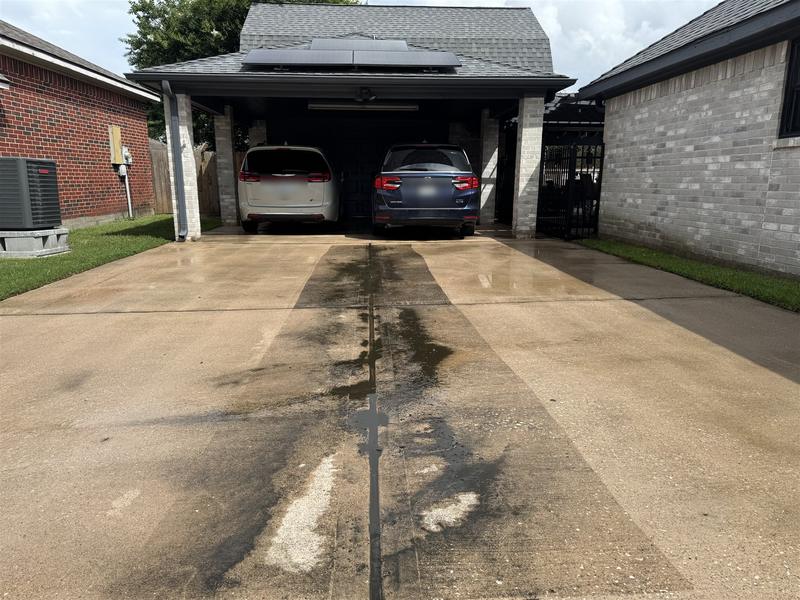
- Concrete flatwork. Driveways and sidewalks handle a powerful cleaning (Consumer Reports), and pressure helps lift the grime ground into the surface. Even here, a surface cleaner spreads the force evenly. See surface cleaner vs wand.
- Stuck-on debris. Gum, caked mud and similar deposits need force to break loose.
- Prep work. Mi-T-M describes its cold-water machines as great tools for stripping paint (Mi-T-M), which tells you how much a strong stream can take off.
How this connects to GPM
PSI and GPM work as a pair. Pressure loosens, flow carries away. If you want the deeper version with "cleaning units" and real machine comparisons, read GPM vs PSI: why water flow often matters more.
What ACE runs
ACE runs a 3,000 PSI, 5.5 GPM cold-water pressure washer. As covered above, that rating describes the machine, not what lands on every surface. Flat concrete gets a 20-inch surface cleaner, which holds its spinning nozzles at a fixed height, and siding and shingle roofs get an X-Jet soft wash at low pressure instead. We pick the method by surface, and the manufacturer's limits come first.
Quick answers
Does PSI really matter when pressure washing?
Yes, but mostly as a limit. PSI is the stripping force that loosens dirt, and it's also what damages a surface when it's too high. Every surface has a published ceiling, and on siding and roofs a cleaning solution at low pressure does the work instead.
Is a higher PSI pressure washer better?
Not automatically. More pressure strips harder, but it can etch concrete, tear wood and push water behind siding. Pressure washer maker Mi-T-M notes that GPM is usually more important to contractors, because cleaning chemicals do much of the work and the job becomes rinsing.
What PSI is safe for vinyl siding?
It depends on the manufacturer. Georgia-Pacific allows 1,500 to 2,400 PSI with a 40-degree tip held at eye level, while ProVia strongly discourages pressure washing its vinyl siding. Check your siding maker's care instructions first.
What PSI is safe for brick?
The Brick Industry Association recommends low pressure, 100 to 400 PSI, for rinsing brick, allows 400 to 800 PSI only if the brick manufacturer permits it, and says pressures over 800 PSI are not appropriate for brick. It also calls for a 25- to 50-degree fan tip held at least 12 inches away.
Why is the PSI on the machine different from what hits the surface?
The rating describes the machine. A narrow tip held close concentrates the stream, while a wide tip held farther away spreads it out, so the same machine can land very hard or quite gently. That's why manufacturers give a tip angle and a distance along with a pressure limit.
Sources
- Pressure Washer FAQ: PSI vs GPM, hot vs cold water, rotary surface cleaners, Mi-T-M Corporation. https://www.mitm.com/consumer/pressure-washers/
- Hot Water Pressure Washer vs. Cold Water: Which is Right for You?, Mi-T-M Corporation. https://www.mitm.com/blog/hot-water-pressure-washer-vs-cold/
- GPM and PSI: How to Pick the Right Pressure Washer Based on Its Cleaning Power, Popular Mechanics. https://www.popularmechanics.com/home/lawn-garden/a65012011/gpm-vs-psi-pressure-washer/
- Technical Note 20: Cleaning Brickwork, Brick Industry Association. https://www.gobrick.com/media/file/20-cleaning-brickwork.pdf
- Siding Cleaning and Maintenance (Technical Bulletin), James Hardie. https://assets.ctfassets.net/dzi2asncd44t/1mcW7pxuTmKq1nWLOgTRbW/40f30c33fe5a8f9b9ea5ffdbffae86ae/20-james-hardie-siding-cleaning-and-maintenance.pdf
- Care and Maintenance, Georgia-Pacific Vinyl Siding. https://www.gpvinylsiding.com/support/care-and-maintenance/
- Siding Cleaning and Maintenance, ProVia. https://www.provia.com/siding/cleaning-maintenance/
- Can You Pressure-Wash It?, Consumer Reports. https://www.consumerreports.org/home-garden/pressure-washers/surfaces-safe-to-clean-with-a-pressure-washer-a5445180933/
- New Concrete? Common Care Questions Answered, Concrete Network. https://www.concretenetwork.com/concrete/new-faqs.html
- Algae & Moss Prevention and Cleaning for Asphalt Roofing Systems, Asphalt Roofing Manufacturers Association (ARMA). https://www.asphaltroofing.org/algae-moss-prevention-cleaning-asphalt-roofing-systems/
Links checked October 19, 2026. This page is general information, not a substitute for your manufacturer's instructions or a product label.