
The short version
- Bleach changes things; it doesn't lift them. Sodium hypochlorite is an oxidizer. It breaks down organic growth and its color, but it isn't a soap.
- Surfactants do the lifting. They help water spread across the surface, grab onto oily grime and hold it until it's rinsed away.
- Dirt uses up bleach. Organic matter reduces chlorine's activity, so grime left in place makes the solution work harder.
What bleach actually does
The active ingredient in household bleach is sodium hypochlorite. It works as an oxidizer. CDC describes chlorine oxidizing enzymes, amino acids and other cell components, and notes that hypochlorites can remove dried or fixed organisms and biofilms from surfaces (CDC). On a house or roof, that organic material is things like algae, mildew, mold and lichen. In our experience, that's why a bleach solution can make dark streaks fade.
That's a chemical reaction with living or once-living material. It doesn't do much to the rest of what makes a wall dirty: dust, pollen, road film, spider webs and the oily grime that binds them to the surface.
Why "lighter" isn't the same as "clean"
Water on its own doesn't clean well, because of surface tension. It beads up instead of spreading out, which slows down how fast it wets the surface (ACI). Oily soil makes it worse, since oil and water don't mix.
Bleach doesn't fix either problem. So a bleach-and-water wash can whiten the growth and still leave a dull film of dirt behind. The surface looks lighter, then looks grimy again as soon as it dries.
What surfactants do
Surfactants (surface active agents) are the main cleaning ingredient in soaps and detergents. The American Cleaning Institute explains how they work (ACI):
- They lower surface tension, so water spreads out and wets the surface instead of beading up.
- Each molecule has two ends: one is attracted to water, the other to oil and grease.
- They surround oily dirt in tiny clusters called micelles, which loosen it from the surface and keep it suspended so it doesn't settle back down.
- The rinse carries the clusters away, dirt and all.
ACI's own booklet adds a detail that matters on a house: surfactants let soil be loosened and removed, "usually with the aid of mechanical action" (ACI). On a soft wash that mechanical action is the rinse water, not high pressure.
Dirt uses up the bleach
There's one more reason grime gets in the way. In its healthcare guidance, CDC explains that organic matter reacts with chlorine, leaving less active chemical available, which is why items are cleaned before chlorine is applied (CDC). The same chemistry applies outdoors: a thick layer of dirt and growth consumes part of the solution before it reaches everything underneath.
Why washes use both
That's why exterior cleaning formulas pair the two. The USDA Forest Service's guide to cleaning mildew from wood explains that the detergent is added to help emulsify mildew and dirt so they can be removed (USDA Forest Service). For mildew on vinyl siding, Georgia-Pacific's care guide adds sodium hypochlorite to a detergent-based cleaning solution rather than using bleach and water alone (Georgia-Pacific). Each ingredient has a job:
Surfactants also help the solution cling to a wall instead of running straight off, which gives it time to work. That time is called dwell time.
Safety note: Never mix bleach with ammonia or with cleaners that contain it. The USDA Forest Service guide repeats this warning and also advises protecting your eyes and skin (USDA Forest Service). Use only products labeled for the job and follow the label.
What ACE uses
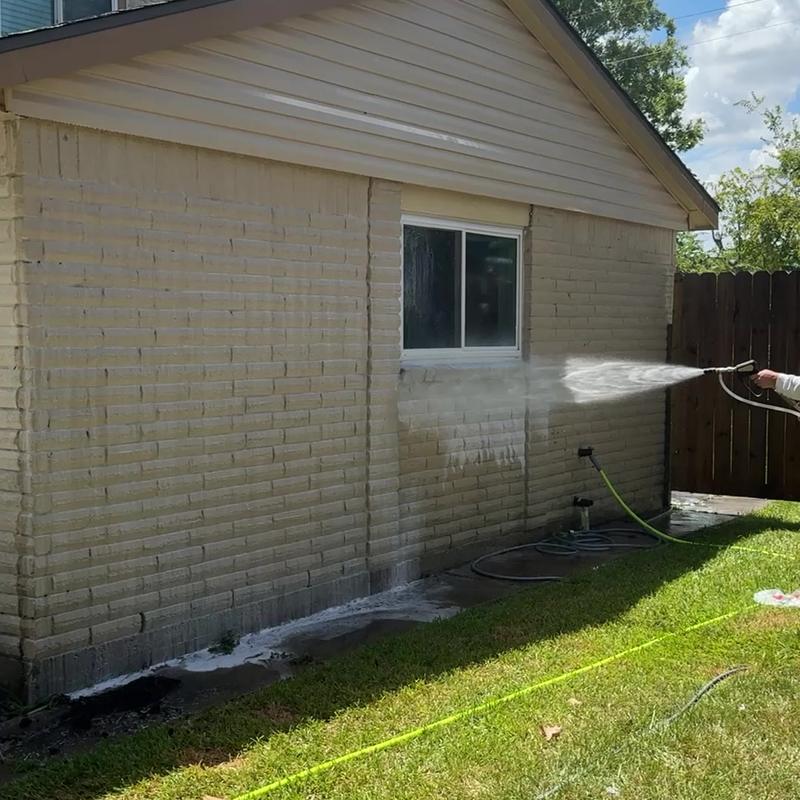
Our soft wash goes on through an X-Jet nozzle, which draws the cleaning solution in at the nozzle itself rather than through the pump, and lets us switch between solution and plain-water rinse (X-Jet). We follow product labels and the siding or roofing manufacturer's instructions. We don't publish mixing recipes, because the right solution depends on the surface and the product. More on how plants and pets are protected in soft wash chemicals, plants and pets.
Quick answers
Does bleach clean siding by itself?
Not completely. Sodium hypochlorite is an oxidizer that breaks down organic growth such as algae and mildew and fades its color, but it isn't a soap. Dust, pollen and oily grime need a surfactant to loosen them and water to rinse them away.
What is a surfactant?
A surfactant, short for surface active agent, is the main cleaning ingredient in soaps and detergents. It lowers water's surface tension so water spreads and wets the surface, and it surrounds oily dirt so the rinse can carry it away.
Why do exterior cleaners add soap to bleach?
Because they do different jobs. The bleach acts on organic growth, the surfactant helps the solution spread, cling and lift dirt, and the rinse water carries it all off. The USDA Forest Service notes that detergent helps emulsify mildew and dirt so it can be removed.
Why does dirt matter if bleach is doing the work?
Organic matter reacts with chlorine and leaves less of it available. CDC makes this point in its healthcare guidance, which is why items are cleaned before chlorine is applied. A heavy layer of grime uses up part of the solution.
Is it safe to mix bleach with other cleaners?
Not with ammonia or products that contain it. Never mix them. Use products labeled for the job, follow the label and protect your eyes and skin.
Sources
- The Chemistry of Cleaning, American Cleaning Institute. https://www.cleaninginstitute.org/understanding-products/science-soap/chemistry-cleaning
- Soaps & Detergents, American Cleaning Institute. https://www.cleaninginstitute.org/sites/default/files/assets/1/AssetManager/SoapsandDetergentsBook.pdf
- Chemical Disinfectants: Chlorine and Chlorine Compounds, U.S. Centers for Disease Control and Prevention (CDC). https://www.cdc.gov/infection-control/hcp/disinfection-sterilization/chemical-disinfectants.html
- Factors Affecting the Efficacy of Disinfection and Sterilization, U.S. Centers for Disease Control and Prevention (CDC). https://www.cdc.gov/infection-control/hcp/disinfection-sterilization/efficacy-factors.html
- Mildew and Mildew Control for Wood Surfaces, USDA Forest Service. https://research.fs.usda.gov/download/treesearch/5675.pdf
- Care and Maintenance, Georgia-Pacific Vinyl Siding. https://www.gpvinylsiding.com/support/care-and-maintenance/
- The X-Jet M5, X-Jet. https://xjetnozzle.com/the-x-jet-m5/
Links checked October 19, 2026. This page is general information, not a substitute for your manufacturer's instructions or a product label.