
The short version
- Dwell time is how long a cleaning solution stays on the surface before it's rinsed off.
- Too short and the chemistry doesn't finish; too long and the solution can dry into residue.
- There's no universal number. It depends on the product label, the surface, the growth and the weather.
What dwell time is
Pressure washing cleans with force. A soft wash cleans with chemistry, and chemistry takes time. Dwell time is the period when the cleaning solution sits on the surface, doing its job, before the rinse. The Brick Industry Association sums up the idea: depend on the chemical reaction of the cleaner, rather than the scrubbing action of the brush or the pressure of the sprayer, and follow the cleaner manufacturer's instructions for application, dwell time and technique (BIA).
What the time is for
- Reaching into texture. The USDA Forest Service's mildew-cleaning method lets the solution sit for 10 to 15 minutes so it can settle into crevices and hard-to-reach places, and warns that skipping this set time may result in an inadequate job (USDA Forest Service).
- Breaking down growth. Sodium hypochlorite oxidizes and breaks down organic growth like algae and mildew; that reaction isn't instant. ARMA's roof guidance has the solution dwell for 15 to 20 minutes before a low-pressure rinse (ARMA).
- Loosening dirt. Surfactants help the solution wet the surface and lift oily soil so the rinse can carry it away (ACI). They also help it cling instead of running straight off.
Too short: rinsed before it finished
Rinse too soon and you're rinsing off a solution that hadn't finished working. The result is often streaks or patches of growth left behind, especially in grooves and textured areas, which then look like the wash "didn't take." See why some washes look dirty again in a month.
Too long: the solution dries
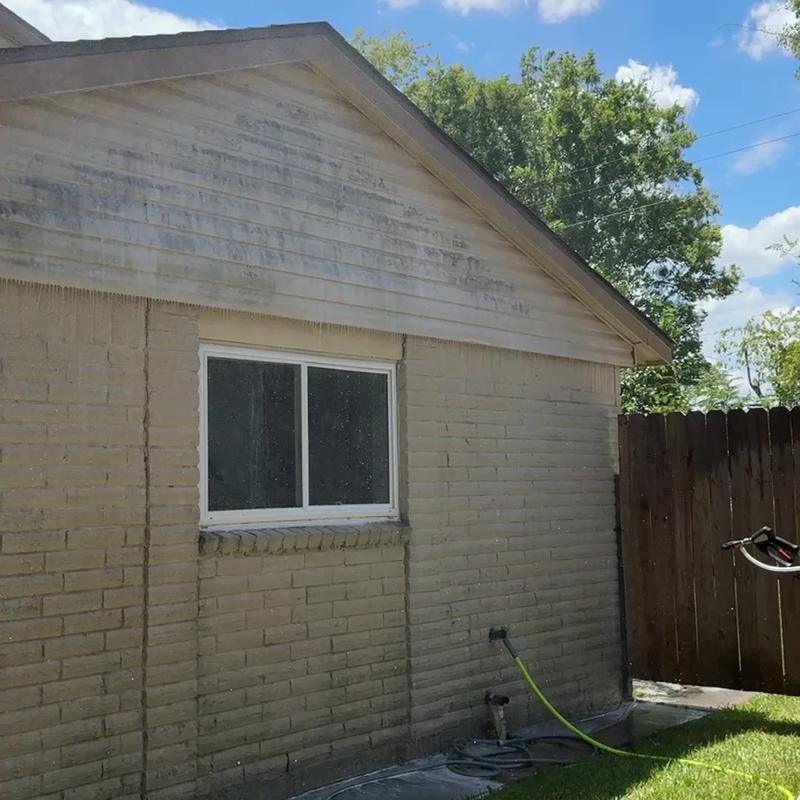
Longer isn't automatically better. ARMA says extended dwell times may sometimes be needed, but to avoid letting the solution dry completely, because that may prevent complete rinsing (ARMA). The Brick Industry Association is stricter on masonry: do not allow cleaning solution to dry on brickwork, rinse before cleaned surfaces can dry, and keep walls wet, especially in hot weather when drying is fast. Dry masonry can absorb the solution and leave white scum or stains (BIA).
That's why surfaces below and around the work are often kept wet, and why the job is done in sections on hot, sunny or windy days.
Why there's no single number
- The product label. Every cleaning product sets its own instructions, and they come first (BIA).
- The surface. Brick, vinyl, stucco, wood and shingles absorb and react differently.
- The growth. Light film and heavy, old growth don't need the same time.
- The weather. Heat, direct sun and wind shorten the time before a solution dries.
A good rinse finishes the job: thorough and even. Georgia-Pacific recommends following any cleaning with a clear-water rinse to minimize streaking (Georgia-Pacific).
How ACE handles dwell time
On a typical house wash, we pre-wet the walls, apply the solution, let it sit for about 5 to 10 minutes and rinse before it dries. The product label and the surface still come first, so the timing can change with the job and the weather.
We apply the solution with an X-Jet, which lets us switch between solution and plain-water rinse at the nozzle (X-Jet). That makes it practical to work in sections and rinse each one at the right time instead of racing the sun.
Quick answers
What is dwell time in soft washing?
Dwell time is how long a cleaning solution stays on a surface before it's rinsed off. It's the time the chemistry needs to break down growth and loosen dirt.
How long should soft wash solution dwell?
There's no single number. It depends on the product label, the surface, how heavy the growth is and the weather. ARMA's roof guidance, for example, describes a 15 to 20 minute dwell, and the USDA Forest Service's mildew method uses 10 to 15 minutes.
What happens if the solution is rinsed too soon?
The chemistry doesn't get time to finish, so growth and dirt can be left behind, especially in grooves and textured areas.
How long does ACE let the solution dwell?
On a typical house wash, we pre-wet the walls, apply the solution, let it sit for about 5 to 10 minutes and rinse before it dries. The product label and the surface come first, so the timing can change with the job and the weather.
Can a cleaning solution be left on too long?
Yes, if it dries. ARMA advises not letting the solution dry completely, because that may prevent complete rinsing, and the Brick Industry Association says never to let cleaning solution dry on brickwork.
Sources
- Technical Note 20: Cleaning Brickwork, Brick Industry Association. https://www.gobrick.com/media/file/20-cleaning-brickwork.pdf
- Algae & Moss Prevention and Cleaning for Asphalt Roofing Systems, Asphalt Roofing Manufacturers Association (ARMA). https://www.asphaltroofing.org/algae-moss-prevention-cleaning-asphalt-roofing-systems/
- Mildew and Mildew Control for Wood Surfaces, USDA Forest Service. https://research.fs.usda.gov/download/treesearch/5675.pdf
- The Chemistry of Cleaning, American Cleaning Institute. https://www.cleaninginstitute.org/understanding-products/science-soap/chemistry-cleaning
- Care and Maintenance, Georgia-Pacific Vinyl Siding. https://www.gpvinylsiding.com/support/care-and-maintenance/
- The X-Jet M5, X-Jet. https://xjetnozzle.com/the-x-jet-m5/
Links checked October 19, 2026. This page is general information, not a substitute for your manufacturer's instructions or a product label.